
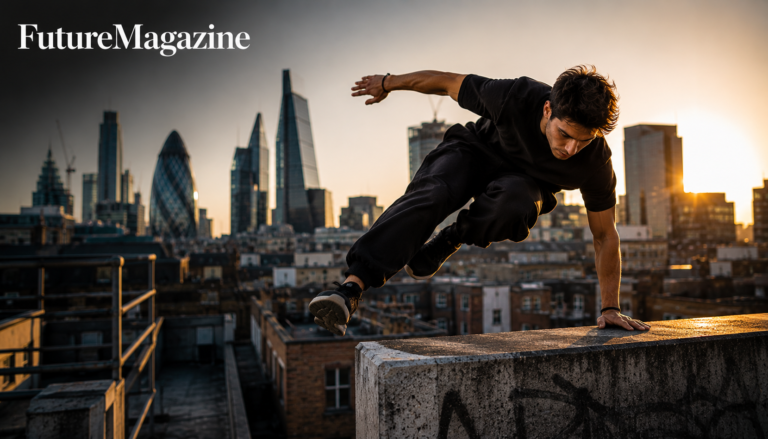

A tracqueur is a person who practises parkour — the discipline of moving fluidly through urban and natural environments using only the human body. The term comes directly from French, the language in which parkour was born, and it carries with it a deep cultural identity tied to movement, freedom, and self-improvement. Whether you have seen breathtaking rooftop sequences in action films or watched street athletes vault over benches in your local city centre, you have witnessed the work of a tracqueur. This guide explores everything you need to know about what they do, how they train, and why the discipline continues to grow worldwide.
What Is a Tracqueur? Definition and Origins
A tracqueur (feminine form: traceuse) is an individual who practises parkour as a discipline, lifestyle, or sport. The word derives from the French verb tracer, meaning to trace or draw a path — reflecting the core philosophy of finding and following the most efficient route through any environment.
The discipline itself was developed in the suburbs of Paris, particularly in Lisses and Évry, during the late 1980s and 1990s. David Belle is widely credited as parkour’s founding figure. Drawing on the méthode naturelle — a physical training system developed by Georges Hébert — Belle and a group of friends known as the Yamakasi refined and popularised what we now recognise as parkour.
Importantly, a tracqueur is not simply someone who performs impressive jumps for an audience. The identity is rooted in a philosophy: that movement should be purposeful, efficient, and honest.
Parkour vs Freerunning: Understanding the Difference
One of the most common points of confusion for those new to the discipline is the distinction between parkour and freerunning — and therefore between a tracqueur and a freerunner.
| Aspect | Parkour (Tracqueur) | Freerunning |
|---|---|---|
| Primary focus | Efficiency and speed | Expression and creativity |
| Aesthetic | Functional movement | Acrobatic and stylistic |
| Founder | David Belle | Sébastien Foucan |
| Use of flips/tricks | Avoided unless functional | Central to the practice |
| Philosophy | Get from A to B optimally | Move freely and expressively |
A tracqueur prioritises getting from one point to another as efficiently as possible. A freerunner, by contrast, embraces acrobatics, flips, and creative expression as central goals. Both disciplines overlap significantly, and many practitioners blend elements of both — but the distinction matters to serious practitioners.
The Core Movements Every Tracqueur Learns
Training as a tracqueur involves mastering a vocabulary of fundamental movements. These techniques form the building blocks of more complex sequences:
- The precision jump — Landing on a precise, often narrow target with controlled balance
- The vault — Clearing an obstacle using the hands and body in a fluid motion (variations include the kong, dash, and speed vault)
- The cat leap — Jumping to a wall and catching it with hands and feet simultaneously
- The tic-tac — Using a wall as a stepping surface to redirect momentum
- The balance walk — Moving along a rail or ledge to develop body awareness
- The roll — Absorbing the impact of a drop safely through a shoulder roll technique
- The underbar — Swinging through a gap between bars or structures
Mastery of these movements does not happen quickly. Experienced tracqueurs emphasise that years of patient, progressive training are required before complex combinations become safe and natural.
How Tracqueurs Train: A Practical Overview
Training for parkour is methodical, not reckless. Contrary to the perception that tracqueurs simply leap between rooftops for thrills, serious practitioners follow a disciplined approach built on progression and safety.
Starting small is essential. Beginners focus on low obstacles — kerbs, low walls, benches — to develop technique before attempting anything at height. A tracqueur who rushes this process risks serious injury and builds poor movement habits.
Conditioning forms the foundation. Upper body strength, core stability, leg power, and flexibility are all critical. Many tracqueurs supplement their practice with calisthenics, gymnastics conditioning, and mobility work.
Environment awareness is non-negotiable. A skilled tracqueur reads their environment constantly — assessing surface grip, structural stability, drop distances, and potential hazards before committing to any movement.
Community learning accelerates progress. Most tracqueurs learn within a community, either at dedicated parkour gyms (known as salles de parkour) or through outdoor training groups. Learning from more experienced practitioners significantly reduces the risk of developing bad habits or attempting movements before the body is ready.
The Philosophy Behind the Practice
What separates a tracqueur from someone who simply performs athletic stunts is the philosophical dimension of the discipline. Parkour carries a set of values that guide how practitioners approach both movement and life.
Efficiency over spectacle. A true tracqueur is not performing for an audience. The goal is always to move well — purposefully and without waste.
Self-improvement as a constant. The practice is often described as a lifelong journey rather than a skill to be completed. There is always a more difficult obstacle, a more refined technique, or a more demanding environment waiting ahead.
Respect for the environment. Tracqueurs are taught to leave spaces as they find them — avoiding damage to property and behaving with consideration for the communities in which they train.
Overcoming fear through discipline. Fear management is a core part of training. A tracqueur does not eliminate fear but learns to assess it honestly, distinguish rational caution from irrational hesitation, and act with clarity.
These values have led many practitioners to describe parkour as something closer to a martial art or meditative practice than a conventional sport.
The Physical and Mental Benefits of Becoming a Tracqueur
The benefits of parkour training extend well beyond physical fitness, though the physical gains alone are considerable.
Physical benefits include:
- Exceptional full-body strength, particularly in the upper body and legs
- Improved spatial awareness and proprioception
- Enhanced agility, coordination, and balance
- Cardiovascular fitness from sustained movement sessions
- Greater flexibility and joint mobility
Mental and psychological benefits include:
- Improved confidence through progressive challenge
- Better focus and present-moment awareness
- Resilience built through repeated exposure to manageable difficulty
- Problem-solving skills developed through route planning and environmental reading
- A strong sense of community and belonging
Research in sports psychology has consistently found that activities combining physical challenge with environmental problem-solving — such as parkour — can have significant positive effects on mental wellbeing, self-efficacy, and stress management.
Tracqueurs in Popular Culture and the Media
The visibility of parkour in mainstream culture has grown enormously since the early 2000s. Several moments stand out as particularly significant in bringing tracqueurs to global attention.
The 2006 James Bond film Casino Royale featured a breathtaking opening chase sequence involving Sébastien Foucan — one of parkour’s founding figures — and introduced millions of viewers worldwide to the discipline’s visual language.
The BBC documentary Jump London (2003) and its follow-up Jump Britain (2005) brought parkour to British television audiences for the first time, showing tracqueurs navigating iconic landmarks with extraordinary fluency.
Since then, parkour has appeared regularly in advertising campaigns, music videos, video games, and competitive sport formats. The discipline was included in the 2018 World Urban Games in Buenos Aires, and discussions around its potential inclusion in future Olympic programmes have been ongoing within both the International Gymnastics Federation (FIG) and dedicated parkour organisations.
Risks, Safety, and the Responsible Tracqueur
No honest account of parkour is complete without addressing risk. The discipline carries genuine physical danger, particularly when practised irresponsibly or without proper progression.
The most common injuries among tracqueurs include ankle sprains and fractures, wrist injuries from poor landing technique, knee stress injuries from repeated high-impact landings, and muscle strains from insufficient warm-up or overtraining.
Risk mitigation strategies used by experienced tracqueurs include:
- Never attempting a movement at full height before it has been mastered at ground level
- Warming up thoroughly before every session
- Training with others who can provide feedback and assistance
- Knowing when to walk away from a challenge that feels genuinely unsafe
- Wearing appropriate footwear designed for grip and impact absorption
The culture within serious parkour communities strongly discourages recklessness. The image of tracqueurs as thrill-seekers ignoring danger is, experienced practitioners argue, a media distortion that misrepresents the discipline’s actual values.
How to Start Your Journey as a Tracqueur
If you are inspired to begin training, the path forward is more accessible than it might appear.
- Find a local parkour gym or community. Many cities now have dedicated indoor facilities where beginners can learn foundational movements safely under supervision.
- Start with conditioning. Before attempting any complex movements, build a base of strength, flexibility, and body awareness through basic exercises.
- Learn the roll first. The parkour roll is the most important safety technique in the discipline. Master it early.
- Train outdoors progressively. Begin with small, low obstacles and build up gradually. Patience is not optional — it is essential.
- Connect with experienced tracqueurs. Community learning is faster, safer, and more enjoyable than training alone.
- Study the philosophy, not just the movements. Understanding why you are training — and what values guide the discipline — will make you a better and safer practitioner.
Key Takeaways
- A tracqueur is a practitioner of parkour — a discipline focused on efficient, fluid movement through environments using only the human body.
- The term comes from French and is deeply connected to the origins of parkour in the suburbs of Paris in the late 1980s and 1990s.
- David Belle is widely recognised as parkour’s founding figure, with the Yamakasi group central to its early development.
- Tracqueurs are distinguished from freerunners by their emphasis on efficiency over expression.
- Training is progressive, methodical, and rooted in a strong philosophical framework of self-improvement and respect.
- Parkour offers significant physical and mental health benefits and has grown into a globally recognised discipline with competitive and cultural dimensions.
- Risk is real but manageable through proper training, patience, and community learning.
FAQ Section
What does tracqueur mean?
A tracqueur is a person who practises parkour. The word comes from the French verb tracer, meaning to trace a path. The feminine form is traceuse. The term reflects the discipline’s French origins and its core philosophy of finding the most efficient route through any environment.
Is parkour the same as freerunning?
They are related but distinct disciplines. Parkour, practised by tracqueurs, focuses on efficiency — getting from A to B as quickly and cleanly as possible. Freerunning, developed by Sébastien Foucan, incorporates acrobatics and creative expression as central goals. Many practitioners blend both approaches.
Where did parkour originate?
Parkour originated in the suburbs of Paris, France, primarily in the towns of Lisses and Évry during the late 1980s and 1990s. David Belle is credited as its founder, drawing inspiration from the méthode naturelle physical training system developed by Georges Hébert.
Is it safe to become a tracqueur?
Parkour carries real physical risk, but these risks are manageable with proper training, progressive skill development, and community guidance. Most injuries occur when practitioners attempt movements beyond their current ability. Starting at a parkour gym under supervision is strongly recommended for beginners.
How long does it take to become a competent tracqueur?
There is no fixed timeline, as progression depends heavily on the individual’s athletic background, training frequency, and commitment to fundamentals. Most experienced tracqueurs suggest that basic movement competence develops over one to two years of consistent training, while true mastery is a lifelong pursuit.
Can anyone become a tracqueur?
Parkour is remarkably accessible. While elite-level parkour requires exceptional athleticism, the fundamentals can be learned by people of a wide range of ages and fitness levels. Many practitioners begin in their teens but adults who start later regularly develop strong skills with dedicated training.
Is parkour legal in the UK?
Parkour is not illegal in the UK as a general activity, though practising on private property without permission may constitute trespass. Parkour UK, the national governing body, actively works with local authorities and landowners to establish legally accessible training spaces across the country.
Are there parkour competitions?
Yes. Competitive parkour has grown significantly, with events organised by bodies including the International Gymnastics Federation (FIG). Speed parkour — in which athletes race through a set course — has been the most commonly used competitive format, though debates continue within the community about whether competition is consistent with parkour’s foundational values.
Conclusion
A tracqueur is far more than an urban athlete performing impressive jumps. The word describes someone committed to a discipline built on efficiency, self-improvement, respect, and a deeply considered philosophy of movement. From its origins in the Paris suburbs to its growing global presence — in competition, in popular culture, and in communities across every major city — parkour continues to attract people who want to engage with the world around them in a more direct, physical, and intentional way. Whether you are considering your first training session or simply curious about the discipline, understanding what it means to be a tracqueur reveals a practice of genuine depth and value.
Read more: Provascin: What It Is and What UK Adults Should Know