
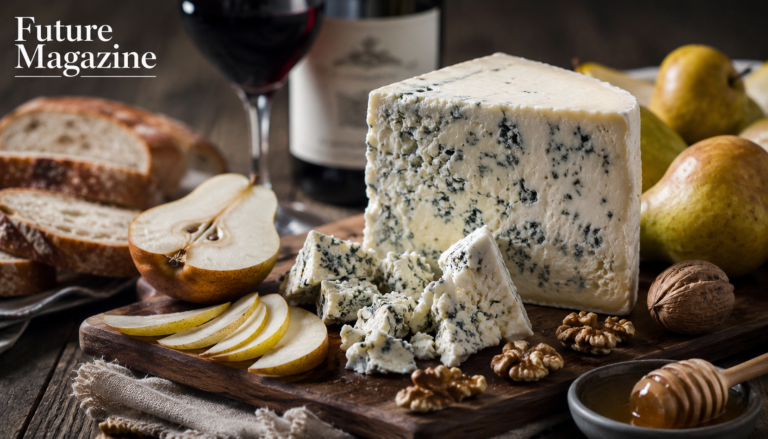

Few cheeses in the world carry the cultural weight, depth of flavour, and centuries of history that Gorgonzola does. This celebrated Italian blue cheese has graced the tables of nobility, inspired generations of cheesemakers, and earned a permanent place in kitchens across the globe. Whether you are discovering it for the first time or looking to deepen your appreciation, this guide covers everything worth knowing — from its ancient origins in the Lombardy region to the best ways to enjoy it today.
What Is Gorgonzola? A Clear Definition
Gorgonzola is a blue-veined Italian cheese made from full-fat pasteurised cow’s milk. It originates from the Lombardy and Piedmont regions of northern Italy and is one of the world’s oldest and most recognised blue cheeses.
The characteristic blue-green veining running through the cheese comes from the introduction of Penicillium glaucum or Penicillium roqueforti mould cultures during the production process. These moulds are entirely safe to consume and are responsible for the cheese’s distinctive sharp, tangy, and complex flavour profile.
Gorgonzola holds Protected Designation of Origin (PDO) status under European Union law — and recognised equivalently in the United Kingdom following Brexit. This means that only cheese produced in specific provinces of Lombardy and Piedmont, following traditional methods, can legally be called Gorgonzola.
The History of Gorgonzola: Centuries in the Making
The origins of Gorgonzola stretch back remarkably far. The cheese takes its name from the town of Gorgonzola, located near Milan in the Lombardy region, where it is believed to have been first produced as early as the 9th or 10th century AD — though some historical accounts suggest even earlier origins.
Legend holds that the cheese was discovered accidentally. Cheesemakers in the Po Valley region would set aside partially made cheese overnight, then mix it with fresh morning curds the following day. The natural moulds present in the ageing caves did the rest, producing the characteristic blue veining that defines the cheese.
By the 15th century, Gorgonzola was already being traded commercially across northern Italy. By the 19th century, it had established a firm international reputation, with exports reaching France, Germany, and Britain.
The Consortium for the Protection of Gorgonzola Cheese (Consorzio per la Tutela del Formaggio Gorgonzola) was established in 1970 to protect the cheese’s authenticity, regulate production standards, and maintain quality control. Today, only around 30 dairies are licensed to produce authentic Gorgonzola, all located within the designated PDO zone.
Gorgonzola Dolce vs Gorgonzola Piccante: Understanding the Two Styles
One of the most important distinctions any Gorgonzola enthusiast should understand is the difference between the cheese’s two primary styles. They share the same name and geographical origin but deliver very different eating experiences.
| Feature | Gorgonzola Dolce | Gorgonzola Piccante |
|---|---|---|
| Also known as | Sweet Gorgonzola, Cremificato | Aged Gorgonzola, Naturale |
| Texture | Soft, creamy, spreadable | Firm, crumbly, dense |
| Flavour | Mild, buttery, gently tangy | Sharp, bold, intensely savoury |
| Ageing period | 2–3 months | 6–12 months |
| Veining | Light blue-green, subtle | Deep blue-green, pronounced |
| Best uses | Spreads, dips, pasta sauces | Salads, cheese boards, risotto |
Gorgonzola Dolce is the younger of the two. Its short ageing period produces a soft, almost mousse-like texture with a mild, creamy flavour that appeals even to those who are new to blue cheese. It is easy to spread and melts beautifully, making it ideal for sauces and dips.
Gorgonzola Piccante undergoes a significantly longer ageing process. The result is a firmer, more crumbly cheese with a deeply concentrated flavour — pungent, sharp, and complex. It is the style traditionally favoured by connoisseurs and works exceptionally well on a cheese board alongside honey, walnuts, and robust red wines.
How Gorgonzola Is Made: The Traditional Production Process
Understanding how Gorgonzola is made adds genuine appreciation for the craft behind every piece.
The production process follows several carefully controlled stages:
- Milk sourcing — Only full-fat cow’s milk from approved herds within the PDO zone is used. The milk is pasteurised before production begins.
- Curd formation — Starter cultures and rennet are added to coagulate the milk into curds, which are then cut and separated from the whey.
- Mould introduction — Penicillium mould spores are added to the curds at this stage, beginning the process that will eventually create the blue-green veining.
- Moulding and salting — The curds are placed into cylindrical moulds and dry-salted or brined to develop the rind and preserve the cheese.
- Needling — After initial ageing, long metal needles are inserted throughout the cheese to create air channels. These channels allow oxygen to penetrate the interior, activating the mould and producing the characteristic veining.
- Ageing — The cheese is aged in temperature-controlled caves or cellars. Dolce rests for 2–3 months; Piccante matures for 6–12 months.
- Quality inspection — Each wheel is inspected and, if approved, wrapped in foil stamped with the Consortium’s mark — a stylised g — guaranteeing authenticity.
The entire process reflects centuries of accumulated craft knowledge, passed down through generations of licensed cheesemakers.
Flavour Profile: What Does Gorgonzola Actually Taste Like?
Describing Gorgonzola’s flavour requires distinguishing between its two styles, as the taste experience differs considerably.
Gorgonzola Dolce delivers:
- Creamy, buttery richness on the palate
- Gentle tanginess with a mild sharpness
- Subtle earthy notes from the mould
- A clean, milky finish
Gorgonzola Piccante delivers:
- Bold, assertive sharpness
- Deep, complex savoury depth
- Pronounced earthy and slightly spicy notes
- A long, lingering finish with mineral undertones
Both styles share a fundamental creaminess rooted in the high-fat cow’s milk from which they are made. However, the ageing process transforms that shared foundation into two remarkably different flavour experiences.
How to Use Gorgonzola in Cooking
Gorgonzola is one of the most versatile cheeses in the kitchen. Its ability to melt smoothly and its bold flavour make it a valuable ingredient across a wide range of dishes.
Classic Italian applications include:
- Gorgonzola risotto — Stirred through towards the end of cooking for a richly flavoured, creamy result
- Pasta al Gorgonzola — A simple sauce of melted Gorgonzola Dolce, cream, and black pepper tossed through tagliatelle or gnocchi
- Pizza Quattro Formaggi — One of the four traditional cheeses alongside mozzarella, fontina, and Parmigiano-Reggiano
- Polenta con Gorgonzola — Melted into soft polenta for a deeply satisfying northern Italian comfort dish
Modern and international uses include:
- Salad dressings and dips using Dolce for its spreadable texture
- Stuffed chicken breasts or beef burgers for a bold flavour hit
- Gorgonzola and pear tart — a classic combination of sweet and savoury
- Cheese boards paired with honey, figs, walnuts, and grapes
One practical tip: Always bring Gorgonzola to room temperature before serving. Cold cheese suppresses the full complexity of its flavour. Allow it to sit at room temperature for at least 30 minutes before eating.
Food and Wine Pairing: Getting the Most from Gorgonzola
Pairing Gorgonzola well elevates both the cheese and whatever accompanies it.
For Gorgonzola Dolce:
- Wines: Moscato d’Asti, Prosecco, or a light Pinot Grigio complement its gentle sweetness
- Foods: Fresh figs, honeycomb, mild crackers, pear slices, and toasted almonds
- Avoid: Overly tannic red wines, which can overwhelm its delicate flavour
For Gorgonzola Piccante:
- Wines: Barolo, Amarone, or a robust Shiraz stand up well to its intensity. Sweet wines such as Sauternes or Passito di Pantelleria offer a classic contrast
- Foods: Walnuts, dark honey, aged balsamic vinegar, dried fruits, and robust sourdough
- Avoid: Bland or very mild accompaniments that will be completely overpowered
The classic Italian pairing of Gorgonzola Piccante with a glass of Barolo — both products of northern Italy — remains one of the great combinations in European gastronomy.
Nutritional Profile and Health Considerations
Like all cheeses, Gorgonzola is a nutrient-dense food that offers genuine benefits alongside considerations for moderation.
Per 100g of Gorgonzola (approximate values):
- Calories: 350–380 kcal
- Protein: 19–21g
- Fat: 28–32g (of which saturated: 18–20g)
- Calcium: approximately 500mg (around 50% of the recommended daily intake)
- Sodium: 900–1,100mg
Nutritional benefits include:
- High-quality complete protein supporting muscle maintenance
- Excellent source of calcium for bone health
- Contains B vitamins, particularly B12 and riboflavin
- Provides phosphorus and zinc
Considerations:
- High in saturated fat — best enjoyed in moderation as part of a balanced diet
- Relatively high in sodium — relevant for those managing blood pressure
- The Penicillium mould is entirely safe for most people, but those with specific mould allergies should consult a healthcare professional
- Individuals who are pregnant or immunocompromised should follow current NHS guidance on consuming blue cheeses, as they are made from mould-ripened cultures
Common Mistakes When Buying and Storing Gorgonzola
Even experienced cheese lovers sometimes handle Gorgonzola incorrectly. Avoiding these mistakes ensures you get the best possible experience.
Buying mistakes:
- Purchasing pre-crumbled Gorgonzola — the quality and flavour degrade rapidly once crumbled; always buy in a cut piece where possible
- Not checking for the Consortium’s foil wrapping and g logo — without it, the cheese is not authentic PDO Gorgonzola
- Choosing based on price alone — cheaper imitations exist and do not deliver the same flavour complexity
Storage mistakes:
- Wrapping in cling film, which traps moisture and encourages unwanted surface mould — use waxed paper or cheese paper instead
- Storing at the wrong temperature — Gorgonzola keeps best between 2°C and 6°C in the refrigerator
- Keeping it too long once opened — Dolce is best consumed within one week of opening; Piccante within two to three weeks
- Freezing — freezing significantly damages the texture and is not recommended
The Future of Gorgonzola: Trends and Global Reach
Gorgonzola continues to grow in international popularity. Export figures reported by the Consortium consistently show increasing demand across North America, Asia, and Australia, driven by growing interest in artisan and European cheeses.
Several trends are shaping its future:
- Sustainable dairy farming — Licensed producers are increasingly adopting more sustainable practices in response to consumer demand and EU environmental targets
- Plant-based alternatives — While no plant-based product replicates authentic Gorgonzola, several producers are developing vegan blue cheese alternatives inspired by its flavour profile
- Gastronomy tourism — The Lombardy region has seen growing interest in cheese tourism, with visitors seeking direct experiences of traditional production
- Digital discovery — Social media platforms, particularly food-focused content on Instagram and YouTube, have introduced Gorgonzola to entirely new global audiences who might never have encountered it through traditional retail
The cheese’s PDO protection ensures that regardless of how the global food landscape evolves, authentic Gorgonzola will remain exactly what it has always been — a product of a specific place, a specific tradition, and centuries of accumulated expertise.
Key Takeaways
- Gorgonzola is a PDO-protected Italian blue cheese made from full-fat cow’s milk, produced exclusively in Lombardy and Piedmont.
- It comes in two distinct styles: Dolce (young, soft, mild) and Piccante (aged, firm, bold).
- The blue-green veining is created by Penicillium mould and activated through a needling process during ageing.
- Only around 30 licensed dairies produce authentic Gorgonzola, all overseen by the Consortium for the Protection of Gorgonzola Cheese.
- It is one of the world’s oldest blue cheeses, with origins dating to at least the 9th or 10th century.
- Gorgonzola is exceptionally versatile in the kitchen — from pasta sauces and risotto to cheese boards and salads.
- Always bring to room temperature before serving and store in waxed paper rather than cling film.
- It pairs beautifully with honey, walnuts, figs, and both sweet and bold red wines.
FAQ Section
What is the difference between Gorgonzola Dolce and Piccante?
Gorgonzola Dolce is young, soft, creamy, and mild, aged for around 2–3 months. Gorgonzola Piccante is aged for 6–12 months, producing a firm, crumbly texture and a much bolder, sharper flavour. Both are authentic Gorgonzola but suit very different uses and palates.
Is Gorgonzola safe to eat during pregnancy?
Current NHS guidance advises pregnant women to avoid mould-ripened soft cheeses, which includes Gorgonzola, due to the small risk of listeria. Always consult a healthcare professional or refer to the latest NHS dietary guidance during pregnancy.
Why does Gorgonzola have blue veins?
The blue-green veins are caused by Penicillium mould cultures introduced during production. Metal needles are inserted into the cheese during ageing to create air channels, allowing oxygen to activate the mould and produce the characteristic veining.
How should Gorgonzola be stored?
Wrap it in waxed or cheese paper — never cling film — and store in the refrigerator between 2°C and 6°C. Consume Dolce within one week of opening and Piccante within two to three weeks. Freezing is not recommended as it damages the texture significantly.
What is PDO status and why does it matter for Gorgonzola?
PDO stands for Protected Designation of Origin. It is a legal framework that guarantees a product is made in a specific region using traditional methods. For Gorgonzola, PDO status means only cheese produced in approved areas of Lombardy and Piedmont, by licensed dairies following regulated processes, can use the name.
What wines pair best with Gorgonzola?
Gorgonzola Dolce pairs well with light, slightly sweet wines such as Moscato d’Asti or Prosecco. Gorgonzola Piccante pairs best with full-bodied reds like Barolo or Amarone, or sweet dessert wines like Sauternes for a classic sweet-savoury contrast.
Can vegans eat Gorgonzola?
Traditional Gorgonzola is not suitable for vegans as it is made from cow’s milk and uses animal rennet. However, several artisan producers are now developing plant-based blue cheese alternatives inspired by Gorgonzola’s flavour profile.
Where is Gorgonzola produced?
Authentic Gorgonzola is produced exclusively in specific provinces of Lombardy and Piedmont in northern Italy, including Milan, Bergamo, Brescia, Como, Cremona, Lecco, Lodi, Monza, Pavia, Varese, Novara, and Vercelli.
Conclusion
Gorgonzola is far more than just a blue cheese. It is a living piece of Italian culinary heritage — shaped by geography, refined over centuries, and protected by law because it is simply irreplaceable. Whether you gravitate towards the gentle creaminess of Dolce or the bold complexity of Piccante, understanding what goes into every wheel deepens the pleasure of every bite. From a simple pasta sauce on a weeknight to the centrepiece of a carefully curated cheese board, Gorgonzola rewards those who take the time to appreciate it properly.
Read more: Tracqueur: The Complete Guide to Parkour’s Most Dedicated Practitioners